
From AI Strategy to Enterprise Execution: Why Most Organizations Are Still Getting It Wrong
Most organizations do not have an AI problem. They have an execution problem.
Across industries, leaders are investing heavily in artificial intelligence. Pilot programs are launched. Tools are deployed. Innovation labs are formed. Boards are briefed.
And yet, measurable enterprise value remains elusive.
The gap is not in ambition. It is not in access to technology. It is in the ability to translate strategy into sustained execution.
This is the AI execution gap.
The Illusion of Progress
Organizations often mistake activity for advancement.
- Pilots are running
- Tools are implemented
- Teams are experimenting
On the surface, it looks like progress.
In reality, many organizations are operating in fragmented pockets of innovation that never scale. AI becomes something that is “being explored” rather than something that is transforming the enterprise.
Research supports this disconnect. While AI adoption is widespread, only a fraction of organizations report achieving significant financial impact from their initiatives.
The issue is not whether organizations are using AI. It is whether they are using it in a way that drives enterprise-level outcomes.
Where AI Strategies Break Down
The breakdown is remarkably consistent across sectors.
1. Lack of Executive Ownership
AI is often delegated rather than owned.
It sits within IT, innovation teams, or isolated business units. Without clear executive accountability, initiatives lack alignment, prioritization, and scale.
2. No Operating Model Redesign
AI is layered on top of existing structures instead of reshaping them.
But AI is not a tool upgrade. It is a fundamental shift in how work gets done. Without redesigning workflows, decision rights, and accountability structures, value stalls.
3. Misalignment Across People, Process, and Technology
Organizations focus heavily on technology while underinvesting in:
- Leadership capability
- Workforce readiness
- Process integration
- Culture
This creates friction that prevents adoption from taking hold.
4. Overemphasis on Tools Instead of Outcomes
Leaders ask:
- “What AI platform should we use?”
Instead of:
- “What business outcome are we trying to achieve?” What is the Value Creation?
This subtle shift in thinking determines whether AI becomes a cost center or a growth engine.
The Shift Leaders Must Make
The organizations that are pulling ahead are not doing more AI. They are doing AI differently.
From Experimentation to Orchestration
AI must move from isolated pilots to coordinated, enterprise-wide initiatives.
From Technology to Business Outcomes
Every initiative must tie directly to measurable impact:
- Revenue growth
- Cost efficiency
- Customer experience
- Speed to market
From Siloed Efforts to Cross-Functional Execution
AI does not live in one function. It requires alignment across:
- Strategy
- Operations
- Finance
- Human capital
From Adoption to Accountability
Execution requires ownership. Leaders must be accountable not just for deploying AI, but for delivering results through it.
The StoneMason Global Perspective
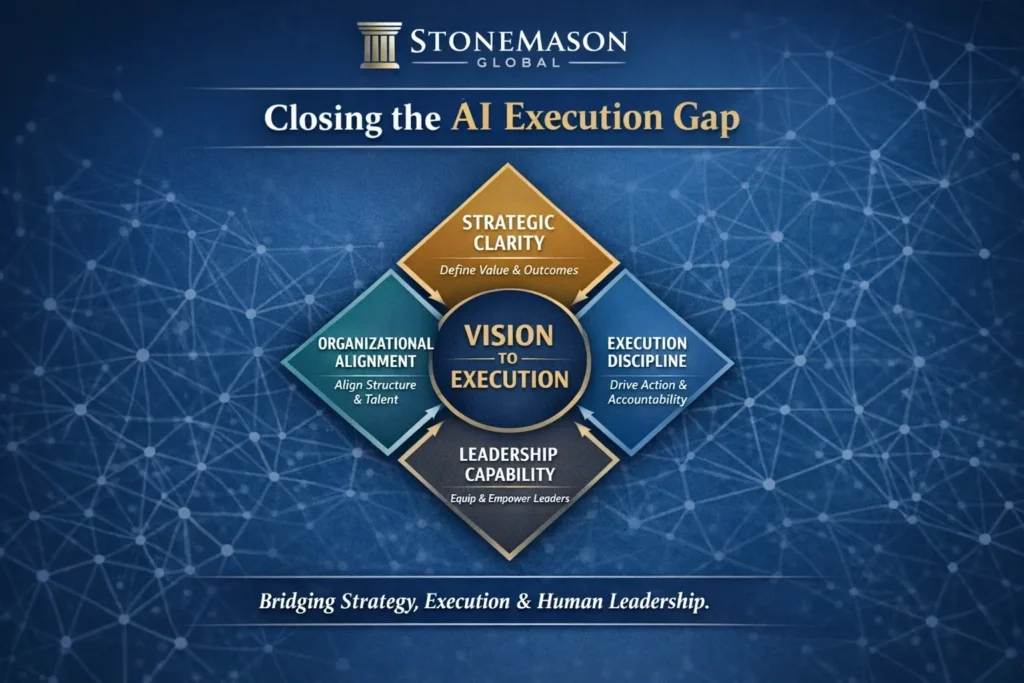
At StoneMason Global, we see this clearly across industries. The challenge is not vision. The challenge is execution.
Bridging vision and execution is where transformation actually happens.
AI success requires four overarching integrated capabilities:
- Strategic Clarity
Define where AI will create meaningful enterprise value.
- Organizational Alignment
Ensure structure, talent, training, culture and leadership are aligned to support transformation.
- Execution Discipline
Translate strategy into actionable plans with clear ownership, data backed pivots and milestones.
- Leadership Capability
Equip leaders to navigate complexity, make decisions with confidence, and lead through change. Without these, even the most sophisticated AI strategy will underperform.
A Practical Leadership Framework for Closing the AI Execution Gap
The StoneMason Global AI Execution FrameworkTM
- Define Value First
- What specific outcomes must AI deliver? What is the business value?
- Where will impact be measurable within 6 to 12 months?
- Align Leadership
- Who owns the outcome?
- Are incentives tied to results?
- Are they prepared and ascribe to continuous learning?
- Redesign Workflows
- How will AI change decision making and processes?
- What must be re-engineered, not just enhanced?
- Build Capability
- Are leaders equipped to lead in an AI-enabled environment? What is needed to “ready” the people and culture?
- Does the workforce understand how to integrate AI into daily work?
- Execute Relentlessly
- Track progress with discipline
- Adjust quickly based on real data
- Maintain focus on outcomes, not activity
What Boards and Executives Should Be Asking Now
- Where are we generating measurable value from AI today?
- Who is accountable for scaling that value across the enterprise?
- What processes have we redesigned, not just digitized?
- Are we building leadership, employee capability and the desired culture alongside technology capability?
These are the questions that separate organizations that experiment from those that transform.
AI will not be the differentiator. Execution will be.
In the years ahead, every organization will have access to powerful technology. Not every organization will have the leadership discipline to translate that technology into results.
The advantage will belong to those who can bridge vision and execution.
Let’s start the conversation: partners@stonemasonglobal.com
Learn more: https://stonemasonglobal.com
© Beth Pritchard and StoneMason Global, LLC 2026. Unauthorized use and/or duplication of this material/content without express and written permission from Beth Pritchard, the content author and owner, is strictly prohibited. Excerpts and links may be used, provided that full and clear credit is given to Beth Pritchard and StoneMason Global with appropriate and specific direction to the original content.